-
 [email protected]
-
 +86-13706666922
[email protected]
+86-13706666922

The tank holds the base liquid while high-shear devices draw in the second phase and reduce droplet size. Continuous circulation through the emulsifying head or rotor-stator assembly creates the mechanical energy needed for dispersion. A dispersed emulsification tank typically operates in batch mode, allowing operators to add ingredients in sequence and monitor the process until the target consistency appears.
The vessel shape and internal baffles influence flow patterns so that material moves steadily toward the shear zone rather than remaining stagnant near the walls. This circulation pattern supports even treatment of the entire batch volume.
A primary agitator keeps the bulk contents in motion and prevents settling or layering. A separate high-shear homogenizer or inline emulsifier then applies intense mechanical force to reduce particle or droplet size. Some designs combine both functions on a single shaft or use dual drives for independent speed control. The dispersed emulsification tank relies on the interaction between these elements to achieve the required fineness.
Rotor-stator gaps, tooth geometry, and rotational speed determine the level of shear delivered. Operators adjust these parameters according to the viscosity and volume of the formulation being processed.
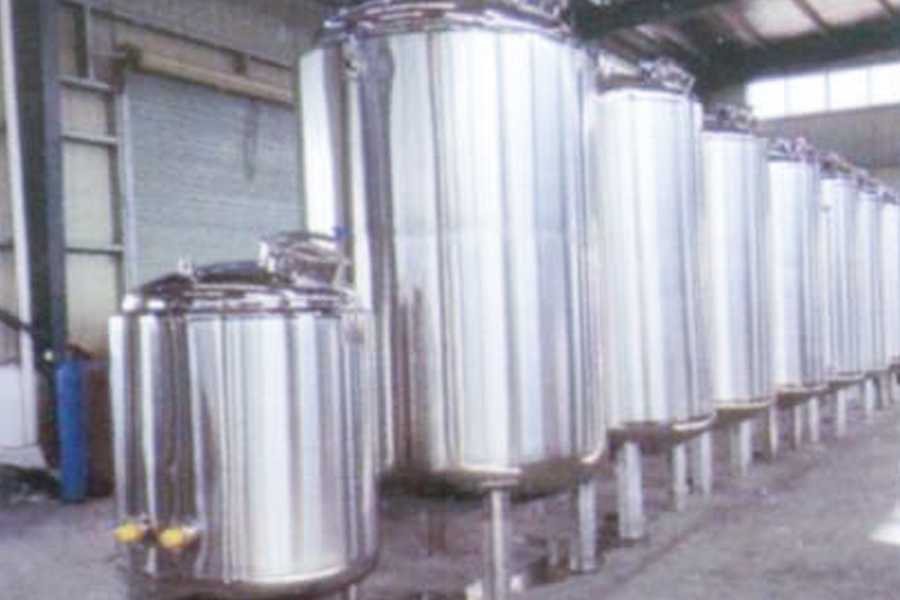
The tank body is commonly fabricated from stainless steel selected for corrosion resistance and cleanability. Interior surfaces receive a smooth finish that limits product adhesion and simplifies discharge. Jacketed walls allow heating or cooling media to circulate, giving temperature control during emulsification. A dispersed emulsification tank may also include insulation to maintain process temperatures with less energy exchange to the surrounding area.
Seals and gaskets at the shaft penetrations and discharge ports are chosen to match the chemical nature of the product. Proper material selection helps the equipment maintain integrity across repeated batches.
Many formulations require controlled heating to reduce viscosity during mixing or controlled cooling to stabilize the finished emulsion. The jacket and optional internal coils provide these temperature adjustments. Sensors for temperature, and in some cases for torque or power draw, give operators feedback on process progress. A dispersed emulsification tank equipped with these instruments supports tighter batch-to-batch consistency.
Variable-speed drives on the agitator and homogenizer allow the operator to start at lower speeds for initial incorporation and then increase shear as the mixture develops. This staged approach reduces the chance of air entrainment or incomplete dispersion.
Cosmetic creams, sauces, dressings, pharmaceutical suspensions, and certain chemical intermediates all rely on effective emulsification or dispersion. In each case the dispersed emulsification tank serves as the central vessel where the critical particle-size reduction occurs. Food processors use it for mayonnaise-style products and flavored emulsions, while personal-care manufacturers employ it for lotions and conditioners.
The same basic equipment platform can be adapted to different viscosities and batch sizes by changing impeller configurations or homogenizer heads. This adaptability makes the tank useful in facilities that produce multiple related products on shared equipment.
Tank volume is selected to match typical batch sizes while leaving sufficient freeboard for any foaming or expansion during processing. Height-to-diameter ratios influence mixing efficiency and the power required to achieve full circulation. A dispersed emulsification tank designed with appropriate proportions moves product through the shear zone at a rate that supports uniform treatment without excessive processing time.
Bottom outlets and optional scrape-surface agitators help discharge higher-viscosity products cleanly. These geometric details affect both process performance and the ease of transferring the finished batch to the next stage.








 English
 عربى
