-
 [email protected]
-
 +86-13706666922
[email protected]
+86-13706666922

In the heart of countless production facilities—from food and beverage plants to pharmaceutical labs and chemical synthesis lines—a single class of equipment plays a foundational role: mixing tanks. These versatile vessels, designed to blend, agitate, and homogenize contents, are far more than simple containers. They are sophisticated processing units critical for achieving consistent product quality, ensuring reaction efficiency, and maintaining sanitary standards across a vast spectrum of industries. The evolution of mixing tanks reflects a continuous drive toward greater precision, control, and scalability in manufacturing.
At their core, mixing tanks are engineered to facilitate the uniform combination of multiple ingredients, whether liquids, solids, or gases. This basic function is paramount. Inconsistent mixing can lead to product defects, such as flavor variations in a sauce, uneven chemical reactions in a polymer batch, or ineffective dispersion of active ingredients in a pharmaceutical formulation. Modern mixing tanks address this challenge through precisely engineered agitation systems. Impellers, ranging from simple propeller styles to complex high-shear designs, are carefully selected and positioned to create specific flow patterns—axial for top-to-bottom blending or radial for intense shearing and dispersion. The selection of the right impeller and its placement within the tank is a science in itself, tailored to the viscosity, density, and sensitivity of the materials being processed.
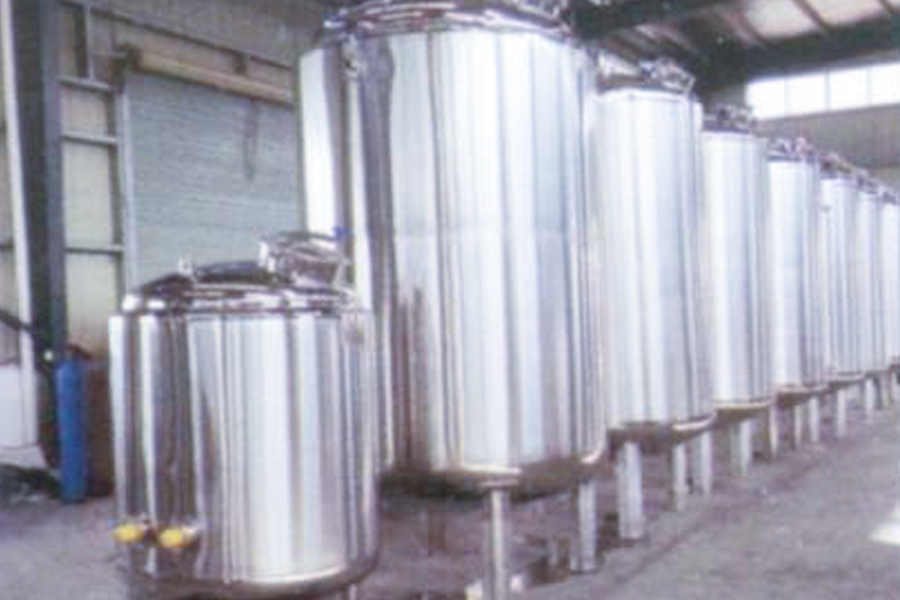
The design and construction of mixing tanks are heavily influenced by their intended application and the nature of the contents. In industries with strict hygiene requirements, such as dairy, brewing, or biotechnology, mixing tanks are predominantly fabricated from polished stainless steel. This material offers outstanding corrosion resistance and allows for interior surfaces that are smooth and free of crevices, enabling thorough cleaning and sterilization, often through Clean-in-Place (CIP) systems. For more corrosive chemical processes, specialized alloys or glass-lined steel may be used. The configuration of mixing tanks also varies widely, including open-top vessels for easy access, closed-top pressurized tanks for reactions requiring a controlled atmosphere, and jacketed designs that allow for precise temperature control via heating or cooling fluids circulating through the outer shell.
The integration of advanced instrumentation and control systems has transformed the mixing tanks of today into highly intelligent process nodes. Sensors continuously monitor critical parameters such as temperature, pH, viscosity, and level inside the mixing tanks. This data is fed into programmable logic controllers (PLCs) or distributed control systems (DCS), which can automate the entire mixing cycle—from ingredient charging and agitation to heating, cooling, and discharge. This automation ensures batch-to-batch repeatability, improves operator safety by small direct contact with process materials, and optimizes energy consumption by running agitators at precisely the required speeds.
Mixing tanks are indispensable workhorses of industrial production, embodying the intersection of mechanical engineering, materials science, and process automation. Their role extends beyond mere blending; they are integral to achieving the chemical, physical, and biological transformations that define modern manufacturing. As industries continue to demand higher purity, greater efficiency, and more agile production methods, the design and application of mixing tanks will continue to evolve, solidifying their status as a cornerstone of reliable and advanced process technology.








 English
 عربى
عربى
