-
 [email protected]
-
 +86-13706666922
[email protected]
+86-13706666922

Behind a lot of the liquids, coatings, and compounds used across everyday industries sits a piece of equipment most people never see: a sealed vessel where raw materials get heated, mixed, and transformed into something new. A chemical reaction kettle is that vessel, and the way it's built shapes everything from reaction speed to the consistency of the final product coming out the other end.
At its core, a chemical reaction kettle holds a batch of material inside a temperature-controlled chamber while an agitator keeps everything moving. That constant motion matters because many chemical reactions depend on even mixing to proceed at a steady rate. Without it, material near the vessel walls might overheat while material at the center barely reacts at all, leading to inconsistent batches.
Temperature control runs alongside the mixing function. Most kettles use a jacketed design, where a secondary layer surrounds the inner vessel and circulates heating or cooling media through it. This lets operators raise or lower the internal temperature gradually rather than applying direct heat to the material itself, which helps avoid scorching or uneven reaction zones near the vessel surface.
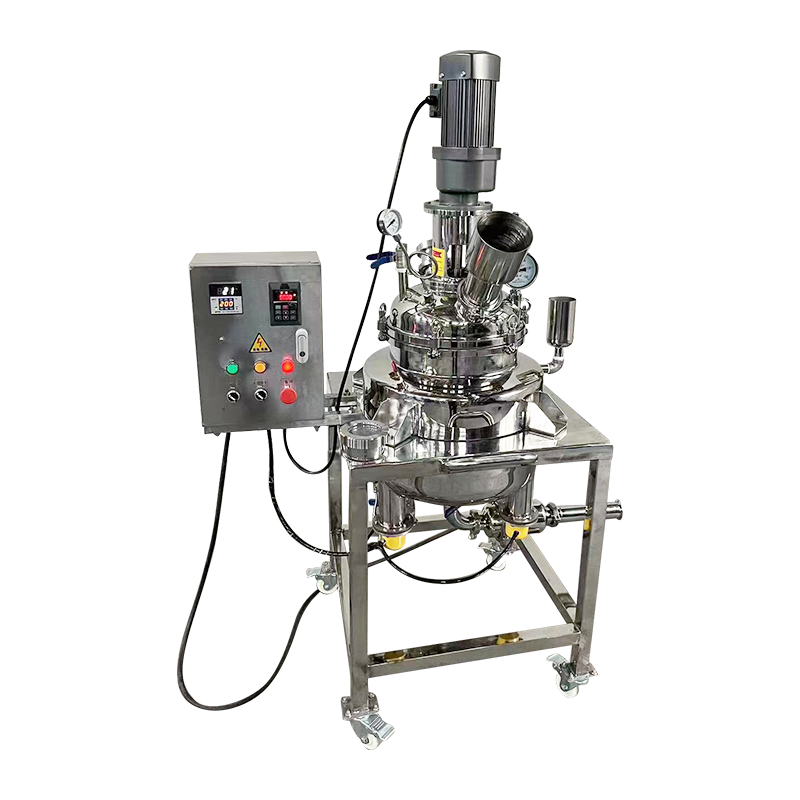
What a chemical reaction kettle is made from depends heavily on what it's meant to process. Stainless steel remains a common choice for general-purpose applications because it resists a wide range of chemicals without reacting with the material inside. For more aggressive or corrosive substances, some kettles use glass-lined interiors or specialized alloy coatings that add another layer of protection against chemical attack on the vessel wall.
A few construction details tend to come up repeatedly when comparing kettle options:
Choosing the right combination of these factors often comes down to the specific properties of the material being processed, particularly its viscosity and how sensitive the reaction is to temperature swings.
Many reactions don't happen cleanly at normal atmospheric pressure. Some processes need elevated pressure to push a reaction forward, while others release gas as a byproduct and need controlled venting to stay stable. A chemical reaction kettle built for these conditions includes reinforced seals, pressure gauges, and safety relief mechanisms that keep the internal environment within a manageable range throughout the batch cycle.
Sealing quality becomes especially important here. A poorly sealed kettle can lose pressure gradually during a reaction, throwing off timing and potentially affecting yield. This is part of why gasket material and closure design get as much attention during equipment selection as the vessel's core dimensions.
The agitator inside a chemical reaction kettle does more than just stir. Its shape and rotation speed influence how thoroughly ingredients blend, how much shear force gets applied to the mixture, and how evenly heat distributes throughout the batch. Thicker or more viscous materials generally call for slower-moving, higher-torque agitators, while thinner liquids can be mixed effectively with faster, lower-torque designs.
Getting this mixing profile right connects directly back to product consistency. A chemical reaction kettle with a mismatched agitator design might technically complete a reaction, but the resulting batch could show variation in texture, color, or concentration from one section of the vessel to another, which is often traced back to uneven mixing rather than a flaw in the raw materials themselves.








 English
 عربى
عربى
