-
 [email protected]
-
 +86-13706666922
[email protected]
+86-13706666922

Across the food, cosmetic, pharmaceutical, and chemical industries, the creation of stable, homogeneous mixtures of immiscible liquids—such as oil and water—relies on a critical piece of process equipment: emulsification tanks. These specialized vessels are engineered to perform the delicate task of forming and stabilizing emulsions, where one liquid is dispersed as fine droplets within another. The design and operation of emulsification tanks directly influence the texture, stability, shelf life, and performance of countless consumer and industrial products, from mayonnaise and salad dressings to lotions, paints, and lubricants.
The core challenge addressed by emulsification tanks is overcoming the natural tendency of oil and water to separate. To achieve a stable emulsion, mechanical energy must be applied to break one phase into microscopic droplets, while emulsifying agents—like lecithin or certain polymers—are often used to coat these droplets and prevent them from coalescing. While high-shear mixers or rotor-stator homogenizers provide the intense mechanical force required for droplet size reduction, the emulsification tank itself is the controlled environment where this process occurs, and where initial mixing, temperature control, and post-homogenization conditioning take place.
The design of emulsification tanks is tailored to promote efficient and uniform processing. They are typically equipped with powerful agitation systems, but the geometry of the tank is equally important. Baffles are commonly installed on the interior walls to prevent vortex formation and ensure the entire volume of material is subjected to the shear forces. The tanks are often jacketed to allow precise temperature control, as viscosity and the effectiveness of emulsifiers can be highly temperature-dependent. For continuous processes, in-line homogenizers may be fed directly from a well-mixed emulsification tank acting as a feed vessel, ensuring a consistent stream for final droplet size reduction.
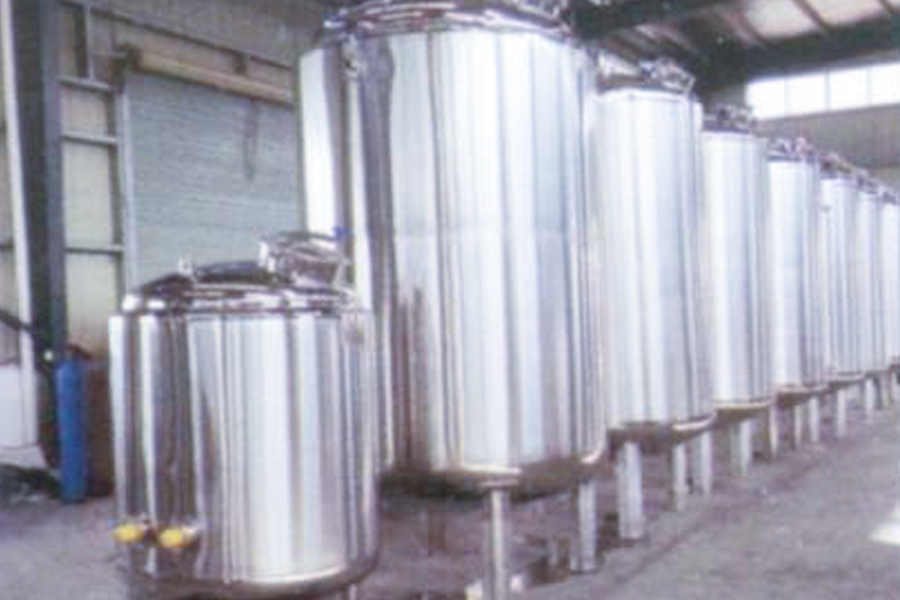
Material selection for emulsification tanks is driven by hygiene and corrosion resistance. In food and cosmetic applications, polished stainless steel with sanitary fittings is the standard, allowing for thorough cleaning and preventing bacterial harborage. The internal surfaces are smooth to avoid areas where product can accumulate and spoil. For more aggressive chemical emulsions, materials may include specialized alloys or glass-lined steel. The scalability of emulsification tanks is also a key consideration; processes developed in small pilot-scale emulsification tanks must be reliably translated to larger production vessels, requiring careful attention to maintaining similar shear rates and mixing dynamics.
The operational role of emulsification tanks often extends beyond the initial mixing phase. They can serve as holding vessels where the emulsion matures or stabilizes after high-shear processing. In some formulations, ingredients are added in a specific sequence within the emulsification tank to achieve the desired structure. Furthermore, modern emulsification tanks are integrated with process control systems that monitor and adjust parameters such as agitator speed, temperature, and phase addition rates in real time. This control is crucial for achieving batch-to-batch consistency, which is vital for product quality and brand integrity in consumer markets.
Emulsification tanks are far more than simple mixing vessels. They are precisely engineered systems that provide the controlled environment necessary to create and preserve delicate microstructures. Their performance is foundational to the quality of a vast array of products that depend on stable emulsions. As consumer demand for sophisticated textures and functional products grows, and as industries seek more efficient and reproducible manufacturing methods, the technology embodied in emulsification tanks will continue to be a focal point of research and development, underscoring their indispensable role in modern formulation science and manufacturing.







 English
 عربى
عربى
